
Class 10 Science Notes — All 13 Chapters, One Board Revision Map
The complete chapter-wise board guide 11,138+ Class 10 students trust — Chemical Reactions to Our Environment, every reaction, diagram & formula in one place, revise fast before boards.
📗 Get the Science Notes — ₹99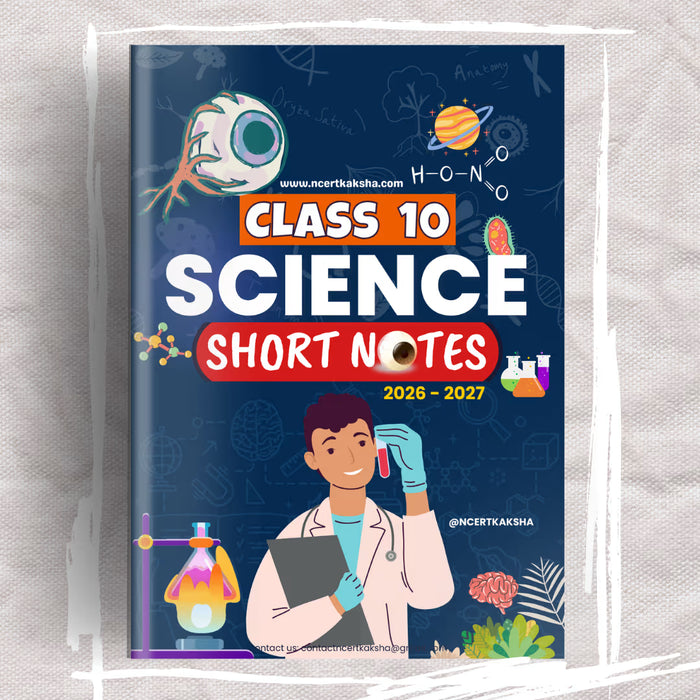
Class 10 Science packs three subjects into one board paper — chemical reactions, electricity numericals, ray diagrams, and life processes all in the same syllabus. That variety is exactly why last-minute revision from the textbook is so slow: you're flipping between Physics formulas, Chemistry reactions, and Biology diagrams across hundreds of pages.
This guide maps the essentials of every Class 10 Science chapter for CBSE 2026-27 — the same map inside the NCERT Kaksha Science Notes, handwritten by district toppers, NITians, and IITians.
📌 What's in this guide
Why Class 10 Science Is Three Subjects in One Paper
Chemistry rewards reaction recall (equations, balancing, tests). Physics rewards formula application and clean ray diagrams (numericals on electricity, mirrors, and lenses). Biology rewards precise terminology and labelled diagrams (life processes, reproduction, heredity). Each needs a slightly different revision style — and a good notes book separates them so you're never mixing approaches.
What's Inside the NCERT Kaksha Science Notes
- ✅ All 13 CBSE 2026-27 chapters — Chemical Reactions to Our Environment
- ✅ 176 pages of colour-coded, handwritten notes
- ✅ Reactions, ray diagrams & formulas all in one place
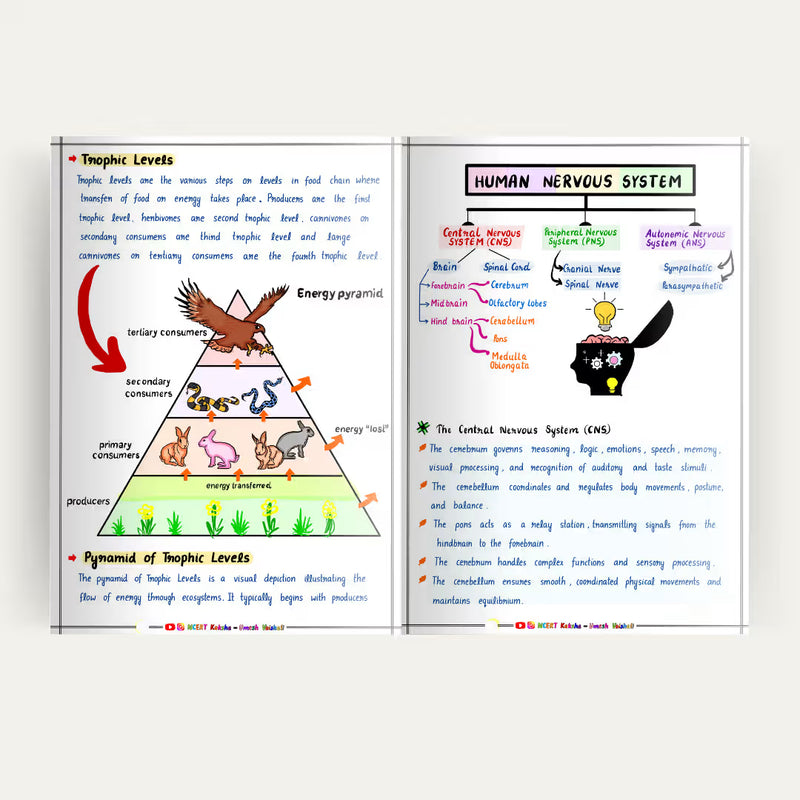
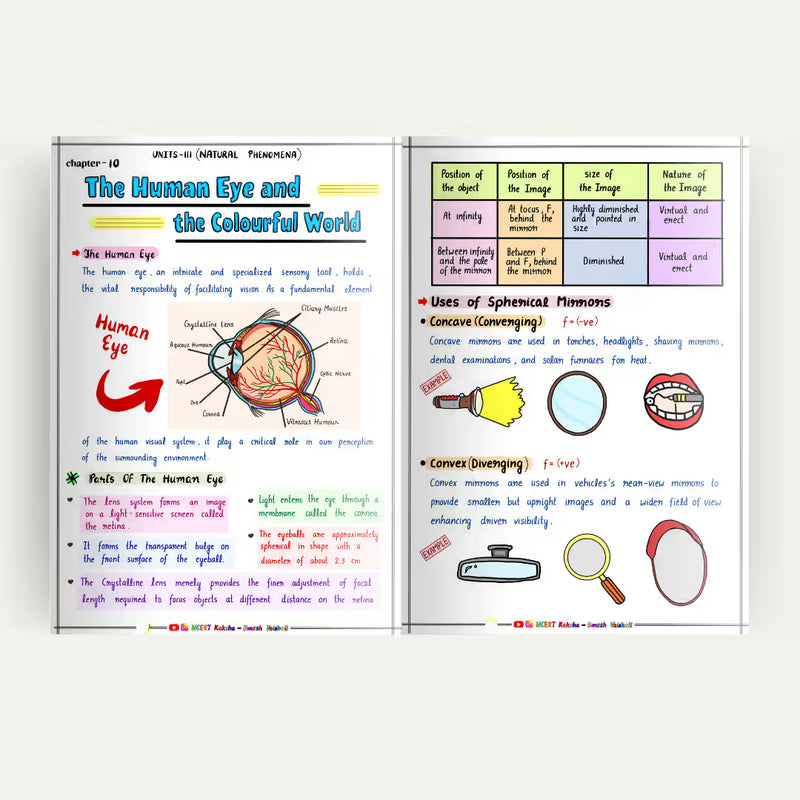
- ✅ Colour-coded diagrams for faster recall in the exam
- ✅ A5 pocket size (21.2 × 14.8 cm)
- ✅ Made by District Toppers, NITians & IITians
- ✅ Choose Printed or instant PDF · Combos: Science, Science+Maths, all-subject
See How Colourful & Organized the Notes Actually Are
All 13 Chapters — Key Points You Cannot Skip
1Chemical Reactions and Equations
Focus on: balancing equations, and the five reaction types — combination, decomposition, displacement, double displacement, and redox (oxidation & reduction).
2Acids, Bases and Salts
Focus on: pH scale, neutralisation, and preparation & uses of common salts (bleaching powder, baking soda, washing soda, plaster of Paris).
3Metals and Non-metals
Focus on: the reactivity series, ionic bonding, and the extraction & corrosion of metals — a reaction-heavy scoring chapter.
4Carbon and its Compounds
Focus on: covalent bonding, homologous series, IUPAC nomenclature, and reactions of ethanol & ethanoic acid.
5Life Processes
Focus on: nutrition, respiration, transportation (heart & blood), and excretion (nephron) — the biggest, most diagram-heavy Biology chapter.
6Control and Coordination
Focus on: the reflex arc, neuron structure, human brain, and plant & animal hormones.
7How do Organisms Reproduce?
Focus on: asexual vs. sexual reproduction, and the human reproductive system diagrams.
8Heredity
Focus on: Mendel's laws, monohybrid & dihybrid crosses, and sex determination in humans.
9Light — Reflection and Refraction
10The Human Eye and the Colourful World
Focus on: defects of vision & their correction, power of a lens (P = 1/f), and dispersion, scattering & atmospheric refraction.
11Electricity
12Magnetic Effects of Electric Current
Focus on: magnetic field of a current-carrying conductor, Fleming's left- & right-hand rules, electromagnetic induction, and the electric motor & generator.
13Our Environment
Focus on: food chains & trophic levels, the 10% energy flow, ozone depletion, and waste management.
How to Use the Science Notes the Right Way
Sirf notes khareedne se marks nahi milte. This is how our top Class 10 students use them:
1. Split revision by subject (Week 1)
Chemistry → drill reactions & balancing. Physics → master mirror/lens/electricity formulas & numericals. Biology → redraw the labelled diagrams. Don't mix the three styles.
2. Prioritise Electricity & Life Processes
These two carry the most marks. Give them extra numerical and diagram practice.
3. Redraw diagrams from memory (daily)
Cover the labels on the eye, nephron, heart, and ray diagrams and redraw until you can do them blind — that's where Science marks are won.
4. Two cold passes before boards
One full pass a month out, one 20-minute pass the exam morning.
Keep an "Error List" — the habit that saves 5+ marks
Note the reactions, sign conventions, and diagram labels you keep slipping on. In the final week, read only this list.
Traditional Revision vs. Board-Notes Revision
| Approach | Textbook | NK Science Notes |
|---|---|---|
| Time to revise full Science | 12–15 hours | 60–90 minutes |
| Reactions & formulas | Scattered across 300+ pages | All in one place |
| Diagram recall | Buried in text | Colour-coded, labelled |
| Portability | Heavy books | A5 pocket size |
| Cost | Textbook + notes | ₹99 (PDF) one-time |
What Real Class 10 Students Are Saying
Class 10 Science Handwritten Notes 2026-27
"Really superb experience with these notes — lots of knowledge gained in a short time and total time-saving method. Thank you Kaksha."
— U Nagamurali, verified buyer"Very nice — so wonderful. After studying this in a unit test he got 20/20 in science."
— Srikanth M, verified buyer"The notes are such a helpful thing for children and for competitive purpose too — a purchase I didn't regret."
— Simran, verified buyer32 verified reviews · 4.5-star average
Frequently Asked Questions
How many chapters are there in Class 10 Science for CBSE 2026-27?
There are 13 chapters covering Physics, Chemistry, and Biology in one board paper — from Chemical Reactions & Equations to Our Environment.
Which is the best notes for Class 10 Science?
The NCERT Kaksha Class 10 Science Notes — 176 pages, all 13 chapters with reactions, ray diagrams and formulas, handwritten by district toppers, PDF from ₹99 (from ₹199).
How many pages is the Class 10 Science notes book?
176 pages of handwritten, chapter-wise notes covering the complete CBSE 2026-27 Science syllabus (Physics + Chemistry + Biology).
Which chapters carry the most marks in Class 10 Science?
Electricity, Magnetic Effects of Current, and Life Processes are consistently among the highest-weight chapters, so give them extra numerical and diagram practice.
Do the notes cover Physics, Chemistry and Biology?
Yes — all three are covered in one book: Chemistry reactions, Physics formulas & ray diagrams, and Biology processes & labelled diagrams.
Is it available as PDF or printed?
Both. Choose Printed (A5, dispatched within 24 hours) or PDF (instant email delivery after payment).
How long does full Science revision take with the notes?
Designed for fast revision. Most students finish one full pass of all 13 chapters in about 60–90 minutes, and an exam-day pass in under 40.
Is there a discount?
Yes — use code TOPPER at checkout for 5% off. All-subject combos (Science+Maths+SST+English) save more.
Ready to Master All Three Science Subjects?
Join 11,138+ Class 10 students who trust NCERT Kaksha for board revision.
₹199₹99Use code TOPPER for 5% off · COD Available
📗 Order Science Notes NowAlso in combos: Science+Maths · All-Subject