
Class 11 Chemistry Short Notes — All 9 Chapters, One Revision Map
The complete chapter-wise guide 20,258+ Class 11 students trust — Basic Concepts to Hydrocarbons, every key concept, formula & reaction in one place.
📘 Get the Short Notes — ₹99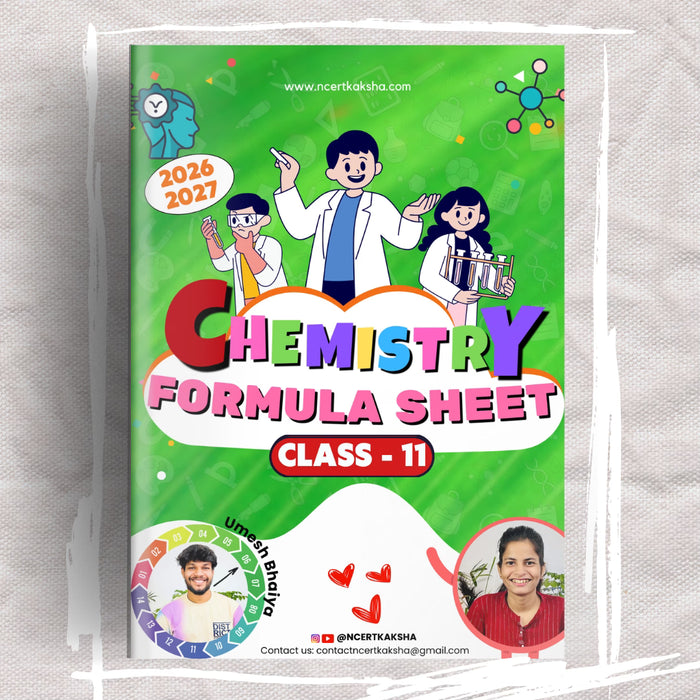
Class 11 Chemistry has a reputation: three subjects hiding inside one. Physical Chemistry is all formulas, Inorganic is memory-heavy, and Organic is a logic game of reactions. Trying to revise all three from fat textbooks is what makes students run out of time. Compact, colour-coded notes solve exactly that.
This guide maps the essentials of every Class 11 Chemistry chapter for CBSE 2026-27 — the same map inside the NCERT Kaksha Chemistry Short Notes, handwritten by IITians, NITians, and NEET toppers.
📌 What's in this guide
Why Class 11 Chemistry Is Three Subjects in One
Physical Chemistry (mole concept, thermodynamics, equilibrium) rewards formula fluency. Inorganic (atomic structure, periodicity, bonding) rewards organised memory. Organic (basics + hydrocarbons) rewards reaction logic. Each branch needs a different revision style — and a good short-notes book separates them cleanly so you're not mixing approaches.
What's Inside the NCERT Kaksha Chemistry Short Notes
- ✅ All 9 CBSE 2026-27 chapters — Basic Concepts to Hydrocarbons
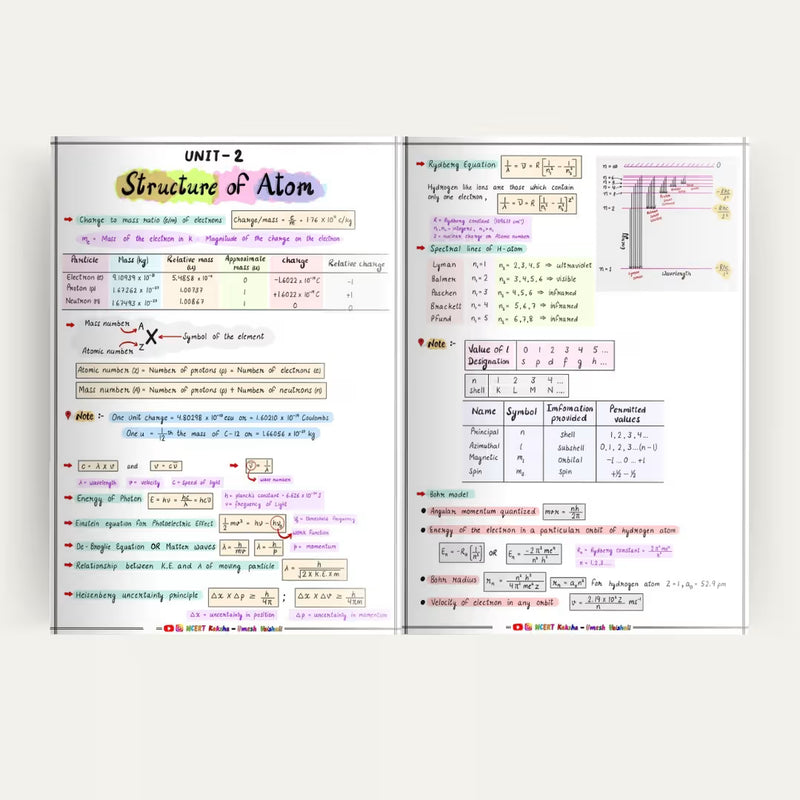
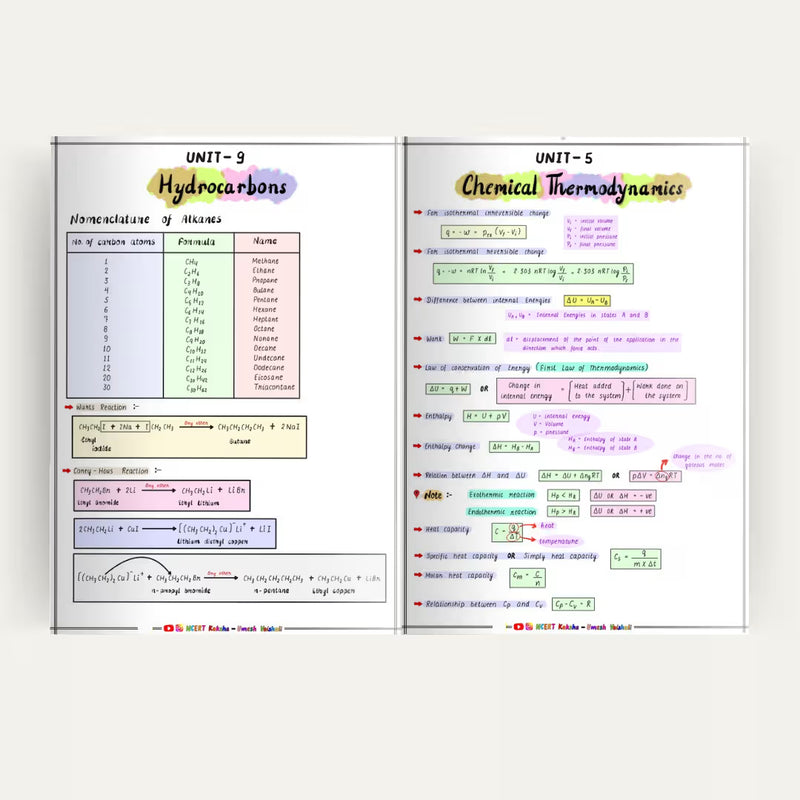
- ✅ 72 pages of colour-coded, handwritten notes
- ✅ Reaction maps for Organic + formula tables for Physical
- ✅ Periodic trends & bonding diagrams for Inorganic
- ✅ A5 pocket size (21.2 × 14.8 cm)
- ✅ Made by IITians, NITians & NEET toppers
- ✅ Choose Printed or instant PDF · Combos: Chem, Phy+Chem, PCM, PCB, PCMB
See How Colourful & Organized the Notes Actually Are
All 9 Chapters — Key Concepts & Formulas
1Some Basic Concepts of Chemistry
2Structure of Atom
3Classification of Elements & Periodicity
4Chemical Bonding & Molecular Structure
5Thermodynamics
6Equilibrium
7Redox Reactions
8Organic Chemistry: Some Basic Principles
9Hydrocarbons
How to Use the Short Notes the Right Way
Sirf notes khareedne se marks nahi milte. This is how our top Class 11 students use them:
1. Master the mole concept first (Week 1)
Chapter 1 powers stoichiometry, equilibrium, and organic calculations. Lock it before anything else.
2. Split revision by branch (Week 2)
Physical → drill the formulas. Inorganic → learn the periodic trends & bonding diagrams. Organic → practise reaction maps. Don't mix the three styles.
3. Reaction map per organic chapter, notes open
For Organic, redraw the reaction map from the notes until you can do it from memory. That's how Organic marks are won.
4. Two cold passes before exams
One full pass a month out, one 20-minute pass the exam morning.
Keep an "Error List" — the habit that saves 5+ marks
Note the reactions and oxidation-number slips you repeat. In the final week, read only this list.
Traditional Revision vs. Short-Notes Revision
| Approach | Textbook | NK Short Notes |
|---|---|---|
| Time to revise full Chemistry | 9–11 hours | 40–45 minutes |
| Concept lookup speed | 2–3 minutes | 5–10 seconds |
| Organic reaction maps | Scattered | One page per chapter |
| Portability | Heavy books | A5 pocket size |
| Cost | Textbook + notes | ₹99 (PDF) one-time |
What Real Class 11 Students Are Saying
Class 11 Chemistry Handwritten Notes 2026-27
"Thank you so much for the formula sheets — they are very useful. Very interested to buy the PCMB set too."
— Abu Haarish, verified buyer"Fantastic and fabulous notes — going to help me a lot in my Foundation journey."
— Pushpit, verified buyer"Best note — clean, compact, and to the point."
— Rashi Verma, verified buyer337 verified reviews · 4.7-star average · 75% five-star
Frequently Asked Questions
How many chapters are there in Class 11 Chemistry for CBSE 2026-27?
There are 9 chapters across Physical, Inorganic, and Organic Chemistry — from Some Basic Concepts of Chemistry to Hydrocarbons.
Which is the best short notes for Class 11 Chemistry?
The NCERT Kaksha Class 11 Chemistry Short Notes — 72 pages, all 9 chapters, colour-coded and handwritten by IITians and NITians, PDF from ₹99 (from ₹199).
How many pages is the Class 11 Chemistry notes book?
72 pages of handwritten, chapter-wise notes covering the complete CBSE 2026-27 Chemistry syllabus.
Which chapter should I study first in Class 11 Chemistry?
Start with the mole concept in Chapter 1 — it powers stoichiometry, equilibrium, and even organic calculations, so mastering it early makes everything else easier.
Is Class 11 Chemistry important for NEET and JEE?
Yes — atomic structure, bonding, equilibrium, and organic basics from Class 11 appear directly in NEET and JEE, making it a crucial foundation year.
Is it available as PDF or printed?
Both. Choose Printed (A5, dispatched within 24 hours) or PDF (instant email delivery after payment).
How long does full Chemistry revision take with the notes?
Designed for 15–45 minutes of full-syllabus revision. Most students finish one pass in about 40 minutes.
Is there a discount?
Yes — use code TOPPER at checkout for 5% off. Combos (Phy+Chem, PCM, PCB, PCMB) save more for multi-subject students.
Ready to Tame All Three Chemistry Branches?
Join 20,258+ Class 11 students who trust NCERT Kaksha for revision.
₹199₹99Use code TOPPER for 5% off · COD Available
📘 Order Chemistry Short Notes NowAlso in combos: PCM · PCB · PCMB · Phy+Chem