
Class 11 Chemistry Short Notes — Maharashtra Board (HSC), All 16 Chapters in One Revision Map
The complete chapter-wise Class 11 guide 4,109+ Maharashtra students trust — Basic Concepts to Chemistry in Everyday Life, every formula, reaction & concept in one place.
📗 Get the Short Notes — ₹99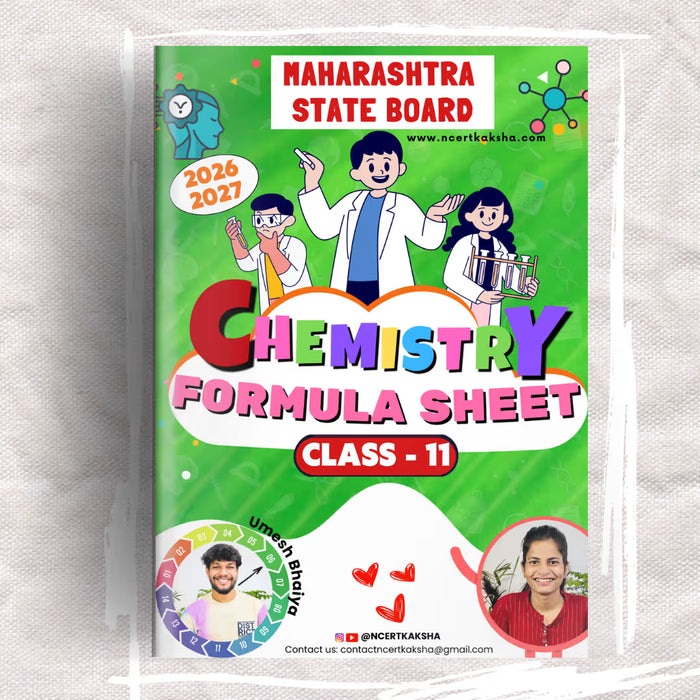
Class 11 Chemistry lays the groundwork for everything in 12th — mole concept, atomic structure and organic basics all return, deeper, next year. The Maharashtra HSC syllabus spans Physical, Inorganic and Organic branches, so there's a lot to organise. Concise notes that separate the three branches make revision far faster.
This guide maps the essentials of the whole HSC Class 11 Chemistry course for 2026-27 — the same map inside the NCERT Kaksha Maharashtra Board Chemistry Short Notes, handwritten by district toppers.
📌 What's in this guide
Why Class 11 Chemistry Is Your Foundation Year
Physical Chemistry (mole concept, atomic structure, states of matter) is formula-and-numerical driven; Inorganic (periodic table, chemical bonding, s-block) is trend- and fact-heavy; Organic (basic principles, hydrocarbons) is reaction-based. All three return in Class 12 and NEET/JEE — so getting the basics organised now pays off for two years.
What's Inside the NCERT Kaksha Chemistry Short Notes
- ✅ All 16 Maharashtra HSC 2026-27 chapters — across Physical, Inorganic & Organic
- ✅ 59 pages of colour-coded, handwritten notes
- ✅ Every formula, reaction & key concept in one place
- ✅ Board & competitive-exam important points highlighted
- ✅ A5 pocket size (21.2 × 14.8 cm)
- ✅ Made by District Toppers, NITians & IITians
- ✅ Choose Printed or instant PDF · Combos: Chem, Phy+Chem, PCM, PCB, PCMB
See How Colourful & Organized the Notes Actually Are
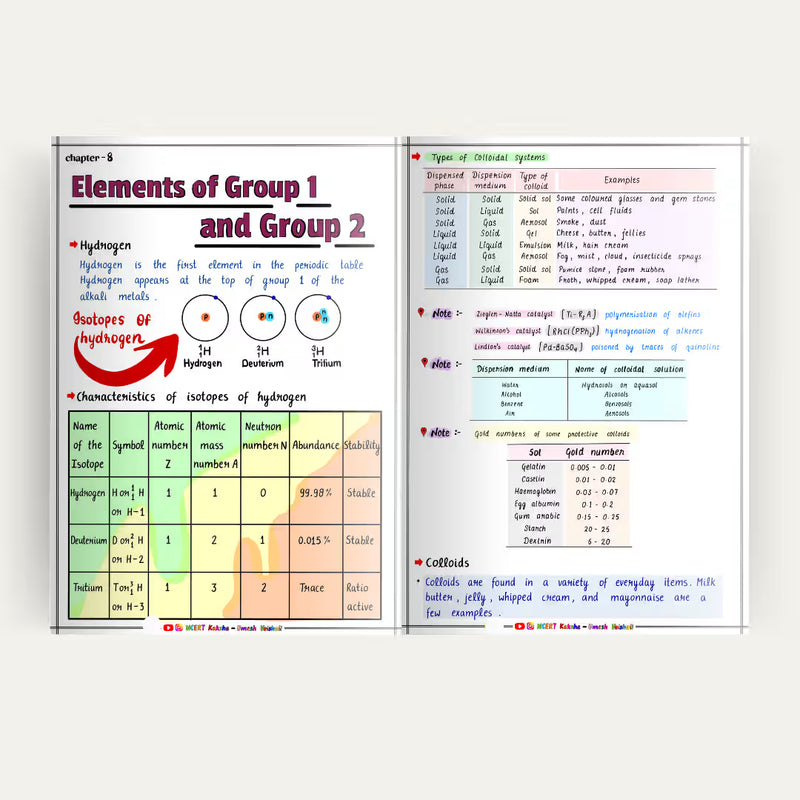

All 16 HSC Chapters — Key Concepts & Formulas You Cannot Skip
Physical Chemistry
1Some Basic Concepts of Chemistry
Focus on: mole concept, stoichiometry & concentration terms.
2Structure of Atom
Focus on: quantum numbers, orbitals & electronic configuration.
3States of Matter (Gases & Liquids)
4Redox Reactions
Focus on: oxidation numbers, balancing redox equations & redox titrations.
5Adsorption and Colloids
Focus on: physisorption vs. chemisorption, and types & properties of colloids.
6Introduction to Analytical Chemistry
Focus on: significant figures, and quantitative analysis basics.
Inorganic Chemistry
7Modern Periodic Table
Focus on: periodic trends — atomic radius, ionisation enthalpy, electronegativity.
8Chemical Bonding
Focus on: VSEPR theory, hybridisation, and molecular orbital theory basics.
9Elements of Group 1 and Group 2
Focus on: the s-block — alkali & alkaline earth metals and their key compounds.
10Elements of Group 13, 14 (Hydrogen & p-block basics)
Focus on: hydrogen, and introductory p-block chemistry & trends.
Organic Chemistry
11Basic Principles of Organic Chemistry
Focus on: IUPAC nomenclature, isomerism, and electronic effects (inductive, resonance).
12Alkanes
Focus on: preparation, properties, and free-radical substitution.
13Alkenes and Alkynes
Focus on: Markovnikov's rule, addition reactions, and acidity of alkynes.
14Aromatic Compounds
Focus on: benzene, aromaticity, and electrophilic substitution.
15Chemical Equilibrium
16Chemistry in Everyday Life
Focus on: drugs, their classification & action, and everyday chemicals — high-scoring, mostly conceptual.
How to Use the Short Notes the Right Way
Sirf notes khareedne se marks nahi milte. This is how our top Class 11 students use them:
1. Lock the foundation chapters first (Week 1)
Mole concept, Structure of Atom, Chemical Bonding and Organic basics carry into Class 12. Master them early.
2. Split Physical, Inorganic & Organic
Revise the three branches in separate sittings so the content doesn't blur.
3. Drill numericals & named reactions
Practise mole and equilibrium numericals, and organic reactions, with the notes open until recall is automatic.
4. Two cold passes before exams
One full pass a month out, one 20-minute pass the exam morning.
Keep an "Error List" — the habit that saves 5+ marks
Note the reactions and formulas you keep slipping on. In the final week, read only this list.
Traditional Revision vs. Short-Notes Revision
| Approach | HSC Textbook | NK Short Notes |
|---|---|---|
| Time to revise full Chemistry | 10–14 hours | 45–60 minutes |
| Formulas & reactions in one place | Scattered | Single section |
| Key concepts | Buried in text | Colour-coded, ready |
| Portability | Thick textbook | A5 pocket size |
| Cost | Textbook + guides | ₹99 (PDF) one-time |
Why 4,109+ Class 11 Students Choose These Notes
Class 11 Chemistry Short Notes — Maharashtra Board (HSC) 2026-27
- ✅ Made by District Toppers, NITians & IITians — real exam insight
- ✅ Based on the latest Maharashtra HSC 2026-27 syllabus — all 16 chapters
- ✅ Colour-coded & compact — faster recall, less overwhelm
- ✅ Trusted by 4,109+ Class 11 students across Maharashtra
Frequently Asked Questions
How many chapters are in Maharashtra HSC Class 11 Chemistry for 2026-27?
There are 16 chapters across Physical, Inorganic and Organic Chemistry — from Some Basic Concepts of Chemistry to Chemistry in Everyday Life — building the base for Class 12.
Which is the best short notes for Class 11 Chemistry Maharashtra Board?
The NCERT Kaksha Class 11 Chemistry Short Notes (Maharashtra Board) — 59 pages covering all 16 HSC chapters with every formula, reaction and concept, handwritten by district toppers, PDF from ₹99 (from ₹199).
How many pages is the Maharashtra HSC Class 11 Chemistry notes book?
59 pages of handwritten, chapter-wise notes covering the complete Maharashtra HSC 2026-27 Class 11 Chemistry syllabus.
Which chapters are most important in Class 11 Chemistry?
Some Basic Concepts (mole concept), Structure of Atom, Chemical Bonding and Basic Principles of Organic Chemistry are the highest-return chapters, as they underpin Class 12.
Are these notes for Maharashtra Board or CBSE?
These are made specifically for the Maharashtra Board (HSC) Class 11 syllabus 2026-27, following the MSBSHSE chapter list.
Is it available as PDF or printed?
Both. Choose Printed (A5, dispatched within 24 hours) or PDF (instant email delivery after payment).
How long does full Chemistry revision take with the notes?
Designed for fast revision. Most students finish one full pass in about 45–60 minutes, and an exam-day pass in under 30.
Is there a discount?
Yes — use code TOPPER at checkout for 5% off. Science combos (Phy+Chem, PCM, PCB, PCMB) save more.
Ready to Master All 16 Class 11 Chemistry Chapters?
Join 4,109+ Maharashtra Class 11 students who trust NCERT Kaksha.
₹199₹99Use code TOPPER for 5% off · COD Available
📗 Order Chemistry Short Notes NowAlso in combos: PCM · PCB · PCMB