
Class 12 Chemistry Formula Sheet — Maharashtra Board (HSC), All 16 Chapters in One Revision Map
The complete chapter-wise HSC guide 11,138+ Maharashtra students trust — Solid State to Green Chemistry, every formula, reaction & named-reaction in one place, revise fast before boards.
📗 Get the Formula Sheet — ₹99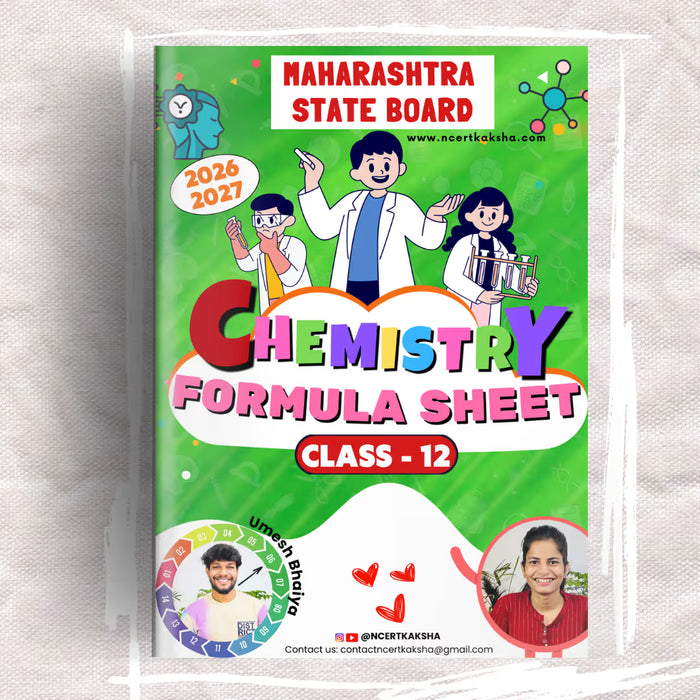
Maharashtra HSC Chemistry punishes small slips — a wrong formula in a numerical, a missing reagent in an organic conversion, a forgotten named reaction. The subject rewards students who have every formula, mechanism and named reaction organised in one place, so nothing gets lost the night before the exam.
This guide maps the essentials of the whole HSC Class 12 Chemistry course for 2026-27 — the same map inside the NCERT Kaksha Maharashtra Board Chemistry Formula Sheet, handwritten by district toppers.
📌 What's in this guide
Why HSC Chemistry Is Three Subjects in One Paper
Physical Chemistry (Solid State, Solutions, Electrochemistry, Kinetics) is formula-and-numerical driven; Inorganic (p-block, transition elements, coordination compounds) is fact- and trend-heavy; Organic (halogen derivatives, alcohols, aldehydes, amines) is all about reactions, reagents and named reactions. Each part needs a slightly different revision style — a good sheet separates them cleanly.
What's Inside the NCERT Kaksha Chemistry Formula Sheet
- ✅ All 16 Maharashtra HSC 2026-27 chapters — Solid State to Green Chemistry & Nanochemistry
- ✅ 61 pages of colour-coded, handwritten notes
- ✅ Every formula, reaction & named reaction in one place
- ✅ Reagents, conditions & mechanisms highlighted
- ✅ A5 pocket size (21.2 × 14.8 cm)
- ✅ Made by District Toppers, NITians & IITians
- ✅ Choose Printed or instant PDF · Combos: Chem, Phy+Chem, PCM, PCB, PCMB
See How Colourful & Organized the Notes Actually Are
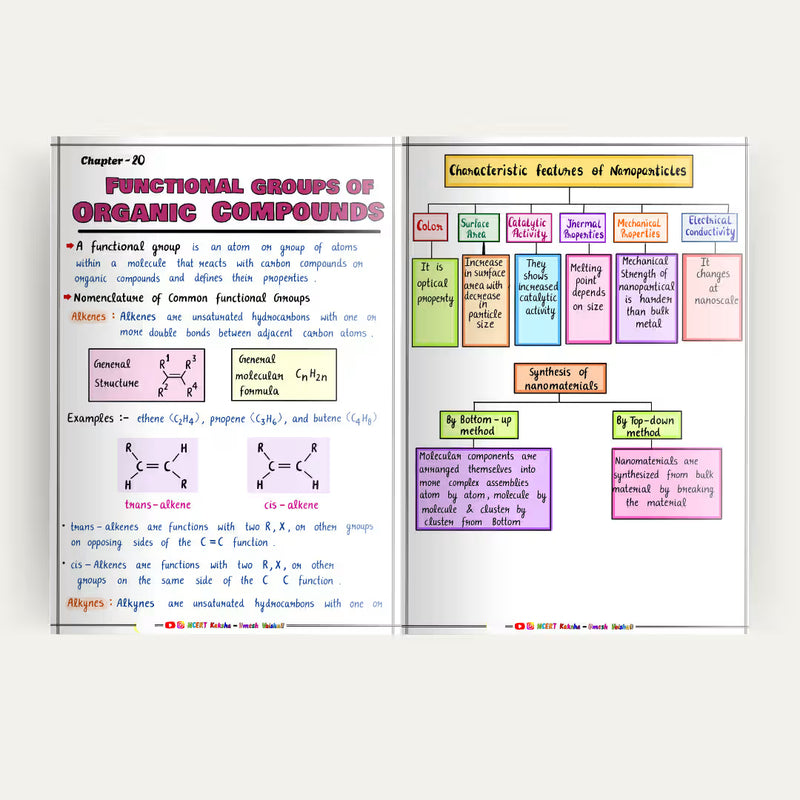
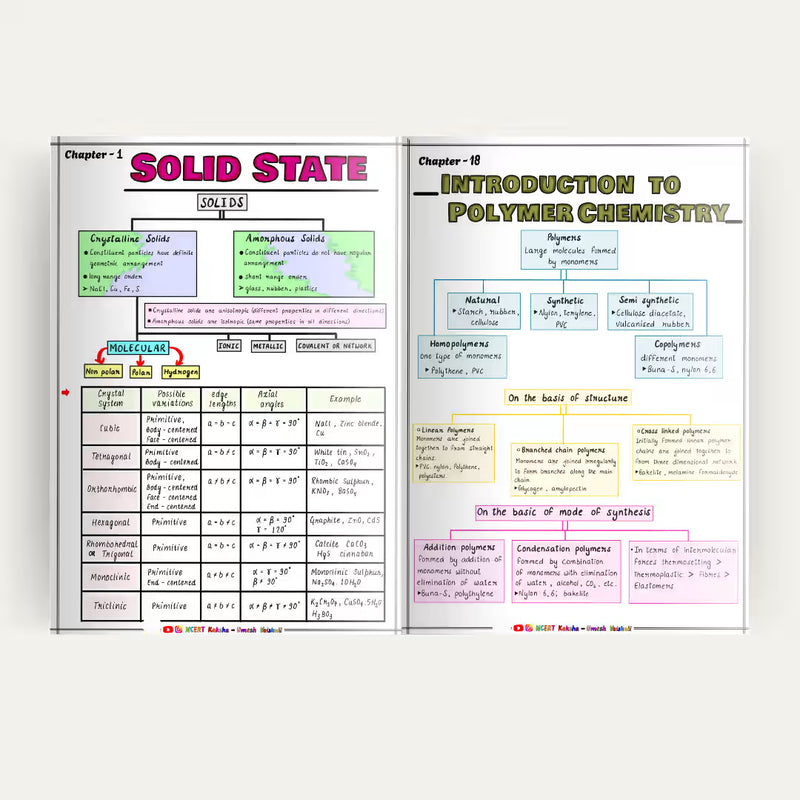
All 16 HSC Chapters — Key Formulas & Reactions You Cannot Skip
Physical Chemistry
1Solid State
Focus on: types of unit cells, packing efficiency, and point defects.
2Solutions
3Ionic Equilibria
4Chemical Thermodynamics
5Electrochemistry
6Chemical Kinetics
Inorganic Chemistry
7Elements of Groups 16, 17 and 18
Focus on: preparation & properties of key compounds, oxidation states, and periodic trends in p-block.
8Transition and Inner Transition Elements
Focus on: electronic configuration, variable oxidation states, colour, and the lanthanide contraction.
9Coordination Compounds
Focus on: Werner's theory, IUPAC nomenclature, isomerism, and Valence Bond & Crystal Field theory.
Organic Chemistry
10Halogen Derivatives
Focus on: SN1 vs. SN2 mechanisms, and preparation & reactions of haloalkanes & haloarenes.
11Alcohols, Phenols and Ethers
Focus on: preparation, acidity of phenols, and named reactions (Reimer-Tiemann, Kolbe).
12Aldehydes, Ketones and Carboxylic Acids
Focus on: named reactions — Aldol, Cannizzaro, Clemmensen, Wolff-Kishner — and nucleophilic addition.
13Amines
Focus on: basicity order, Hinsberg test, diazonium salts & their coupling reactions.
14Biomolecules
Focus on: carbohydrates, proteins, structure of DNA/RNA, and vitamins & enzymes.
15Introduction to Polymer Chemistry
Focus on: classification of polymers, addition vs. condensation, and important commercial polymers.
16Green Chemistry and Nanochemistry
Focus on: principles of green chemistry, and the basics & applications of nanomaterials — high-scoring, mostly conceptual.
How to Use the Formula Sheet the Right Way
Sirf notes khareedne se marks nahi milte. This is how our top HSC students use them:
1. Split Physical, Inorganic & Organic (Week 1)
Revise formula-based Physical, trend-based Inorganic, and reaction-based Organic in separate sittings so nothing blurs.
2. Drill named reactions daily
Aldol, Cannizzaro, Reimer-Tiemann and the rest are near-guaranteed marks. A daily 10-minute recall locks them in.
3. Solve numericals with the formulas beside you
Work through Electrochemistry, Kinetics and Solutions numericals with the sheet open until the formulas are automatic.
4. Two cold passes before boards
One full pass a month out, one 20-minute pass the exam morning.
Keep an "Error List" — the habit that saves 5+ marks
Note the reagents, conditions and formulas you keep slipping on. In the final week, read only this list.
Traditional Revision vs. Formula-Sheet Revision
| Approach | HSC Textbook | NK Formula Sheet |
|---|---|---|
| Time to revise full Chemistry | 11–15 hours | 50–65 minutes |
| Formulas & reactions in one place | Scattered | Single section |
| Named reactions | Buried in text | Colour-coded, ready |
| Portability | Thick textbook | A5 pocket size |
| Cost | Textbook + guides | ₹99 (PDF) one-time |
Why 11,138+ HSC Students Choose These Notes
Class 12 Chemistry Formula Sheet — Maharashtra Board (HSC) 2026-27
- ✅ Made by District Toppers, NITians & IITians — real exam insight
- ✅ Based on the latest Maharashtra HSC 2026-27 syllabus — all 16 chapters
- ✅ Colour-coded & compact — faster recall, less overwhelm
- ✅ Trusted by 11,138+ students across Maharashtra
Frequently Asked Questions
How many chapters are in Maharashtra HSC Class 12 Chemistry for 2026-27?
There are 16 chapters covering Physical, Inorganic and Organic Chemistry — from Solid State to Green Chemistry & Nanochemistry — in a 70-mark theory paper with 30 marks for practicals.
Which is the best formula sheet for Class 12 Chemistry Maharashtra Board?
The NCERT Kaksha Class 12 Chemistry Formula Sheet (Maharashtra Board) — 61 pages covering all 16 HSC chapters with every formula, reaction and named reaction, handwritten by district toppers, PDF from ₹99 (from ₹199).
How many pages is the Maharashtra HSC Chemistry notes book?
61 pages of handwritten, chapter-wise notes covering the complete Maharashtra HSC 2026-27 Chemistry syllabus.
Which chapters are most important in HSC Chemistry?
Electrochemistry, Chemical Kinetics and the organic chapters (Aldehydes/Ketones/Carboxylic Acids, Alcohols/Phenols/Ethers) are the highest-scoring, most predictable topics, so prioritise them.
Do the notes cover named reactions and mechanisms?
Yes — every important named reaction (Aldol, Cannizzaro, Reimer-Tiemann and more), reagent and mechanism is laid out clearly in the organic section.
Is it available as PDF or printed?
Both. Choose Printed (A5, dispatched within 24 hours) or PDF (instant email delivery after payment).
How long does full Chemistry revision take with the formula sheet?
Designed for fast revision. Most students finish one full pass in about 50–65 minutes, and an exam-day pass in under 35.
Is there a discount?
Yes — use code TOPPER at checkout for 5% off. Science combos (Phy+Chem, PCM, PCB, PCMB) save more.
Ready to Master All 16 HSC Chemistry Chapters?
Join 11,138+ Maharashtra HSC students who trust NCERT Kaksha for board revision.
₹199₹99Use code TOPPER for 5% off · COD Available
📗 Order Chemistry Formula Sheet NowAlso in combos: PCM · PCB · PCMB