
Class 9 Science Notes — All 12 Chapters, One Revision Map
The complete chapter-wise guide 11,138+ Class 9 students trust — Matter to Food Resources, every reaction, diagram & formula in one place, revise in minutes not hours.
📗 Get the Science Notes — ₹99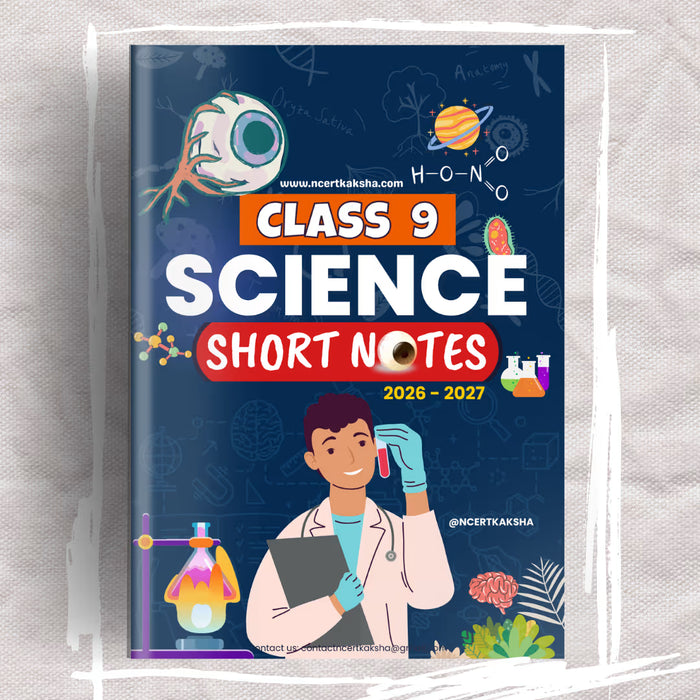
Class 9 Science is where the real foundation is built — three subjects packed into one, from chemical reactions to Newton's laws to cell structure. Get the base solid here and Class 10 feels easy; leave gaps and they follow you into the boards. The challenge is the sheer variety: reactions to balance, formulas to apply, and diagrams to memorise, all in one syllabus.
This guide maps every Class 9 Science chapter for CBSE 2026-27 — the same map inside the NCERT Kaksha Science Notes, handwritten by district toppers, NITians, and IITians.
📌 What's in this guide
Why Class 9 Science Is Your Foundation Year
Chemistry rewards reaction and definition recall (matter, atoms, molecules). Physics rewards formula application (motion, force, gravitation, work, sound). Biology rewards precise terms and labelled diagrams (cell, tissues). Each branch needs a slightly different revision style — and a good notes book separates them cleanly so you're never mixing approaches.
What's Inside the NCERT Kaksha Science Notes
- ✅ All 12 CBSE 2026-27 chapters — Matter in Our Surroundings to Improvement in Food Resources
- ✅ 113 pages of colour-coded, handwritten notes
- ✅ Reactions, formulas & definitions all in one place
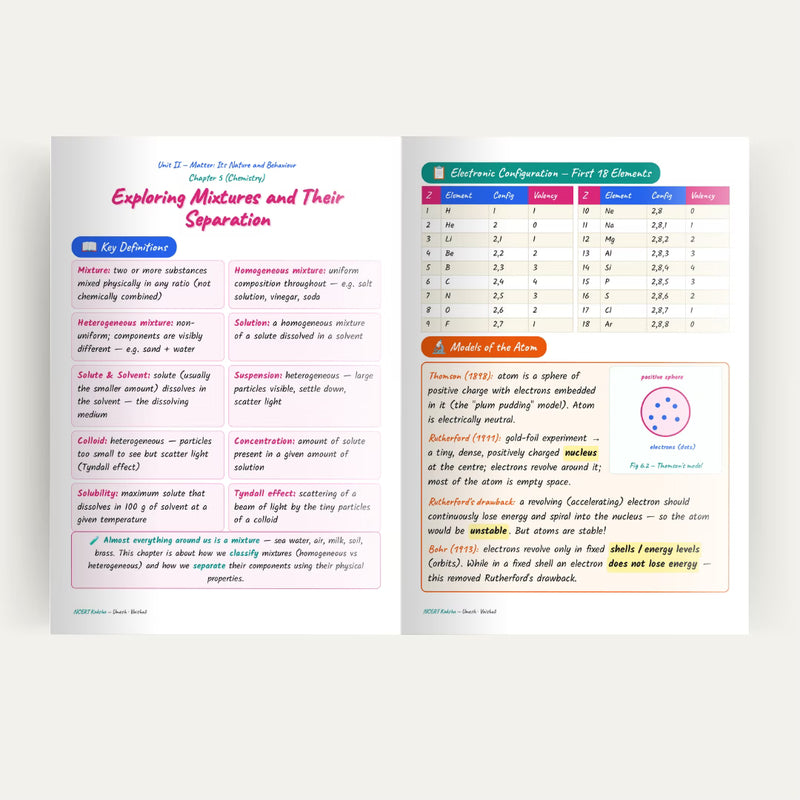
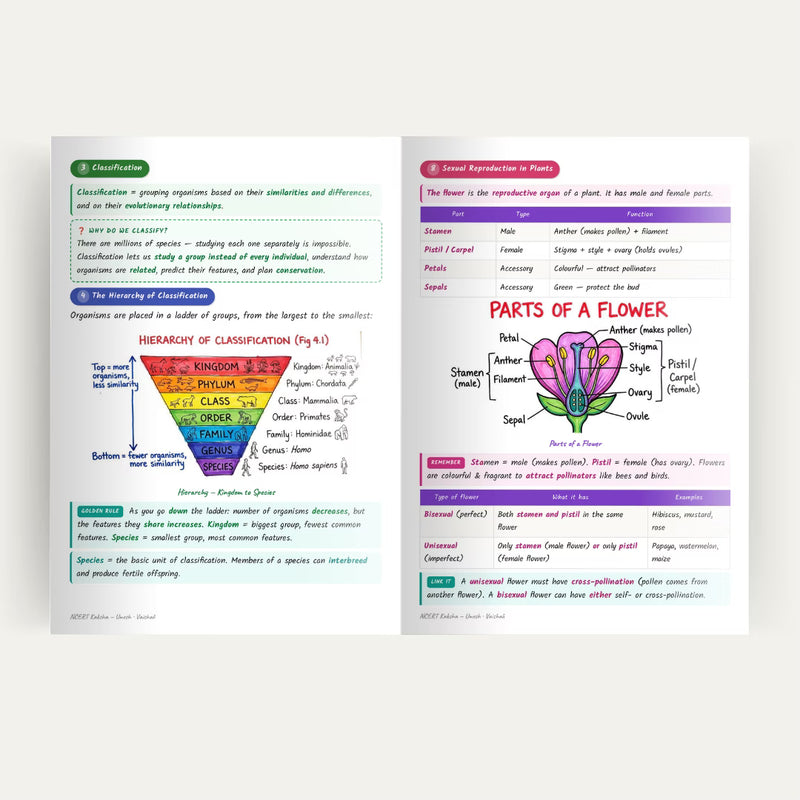
- ✅ Colour-coded diagrams & flowcharts — cell structure, motion graphs & reactions
- ✅ A5 pocket size (21.2 × 14.8 cm)
- ✅ Made by IITians, NITians & NEET toppers
- ✅ Choose Printed or instant PDF · Combos: Science, Sci+Maths, Sci+Eng, all-subject
See How Colourful & Organized the Notes Actually Are
All 12 Chapters — Key Points You Cannot Skip
1Matter in Our Surroundings
Focus on: states of matter, changes of state, evaporation, and the effect of temperature & pressure.
2Is Matter Around Us Pure?
Focus on: mixtures vs. compounds, solutions & suspensions, colloids, and separation techniques.
3Atoms and Molecules
4Structure of the Atom
Focus on: Thomson, Rutherford & Bohr models, electron distribution (Bohr-Bury rules), valency, and isotopes.
5The Fundamental Unit of Life
Focus on: the cell, plant vs. animal cell diagrams, organelle functions, and osmosis & diffusion.
6Tissues
Focus on: plant tissues (meristematic & permanent) and animal tissues (epithelial, connective, muscular, nervous) — a diagram-heavy scoring chapter.
7Motion
8Force and Laws of Motion
9Gravitation
10Work and Energy
11Sound
12Improvement in Food Resources
Focus on: crop production & management, animal husbandry, and methods to improve yield — a recall-based scoring chapter.
How to Use the Science Notes the Right Way
Sirf notes khareedne se marks nahi milte. This is how our top Class 9 students use them:
1. Split revision by branch (Week 1)
Chemistry → drill reactions & the mole concept. Physics → master the motion, force & work formulas. Biology → redraw cell & tissue diagrams. Don't mix the three styles.
2. Prioritise the Physics block
Motion, Force, Gravitation, Work and Sound carry the numericals and feed straight into Class 10. Give them extra practice.
3. Redraw diagrams from memory (daily)
Cover the labels on the cell and tissue diagrams and redraw them until you can do them blind — that's where Biology marks are won.
4. Two cold passes before exams
One full pass a month out, one 20-minute pass the exam morning.
Keep an "Error List" — the habit that saves 5+ marks
Note the reactions, sign conventions, and diagram labels you keep slipping on. In the final week, read only this list.
Traditional Revision vs. Short-Notes Revision
| Approach | Textbook | NK Science Notes |
|---|---|---|
| Time to revise full Science | 10–13 hours | 50–70 minutes |
| Reactions & formulas | Scattered across 300+ pages | All in one place |
| Diagram recall | Buried in text | Colour-coded, labelled |
| Portability | Heavy books | A5 pocket size |
| Cost | Textbook + notes | ₹99 (PDF) one-time |
What Real Class 9 Students Are Saying
Class 9 Science Handwritten Notes 2026-27
"Terrific — it explains very nicely."
— Roshan Gupta, verified buyer"Fabulous! Trust me guys it's very helpful."
— Sona Singh, verified buyer"Perfect product — best."
— Sneha Singharwa, verified buyer192 verified reviews · 4.2-star average
Frequently Asked Questions
How many chapters are there in Class 9 Science for CBSE 2026-27?
There are 12 chapters covering Physics, Chemistry, and Biology — from Matter in Our Surroundings to Improvement in Food Resources.
Which is the best notes for Class 9 Science?
The NCERT Kaksha Class 9 Science Notes — 113 pages, all 12 chapters with reactions, formulas & diagrams, handwritten by IITians and NITians, PDF from ₹99 (from ₹199).
How many pages is the Class 9 Science notes book?
113 pages of handwritten, chapter-wise notes covering the complete CBSE 2026-27 Science syllabus (Physics + Chemistry + Biology).
Do the notes cover Physics, Chemistry and Biology?
Yes — all three are covered in one book: Chemistry reactions & mole concept, Physics formulas & numericals, and Biology cell & tissue diagrams.
Is Class 9 Science important for Class 10 boards?
Yes — Class 9 is the foundation year. Atoms, motion, force, and cell biology from Class 9 feed directly into the Class 10 board syllabus, so a strong base pays off.
Is it available as PDF or printed?
Both. Choose Printed (A5, dispatched within 24 hours) or PDF (instant email delivery after payment).
How long does full Science revision take with the notes?
Designed for fast revision. Most students finish one full pass of all 12 chapters in about 50–70 minutes, and an exam-day pass in under 30.
Is there a discount?
Yes — use code TOPPER at checkout for 5% off. All-subject combos (Science+Maths+SST+English) save more.
Ready to Build a Strong Science Foundation?
Join 11,138+ Class 9 students who trust NCERT Kaksha for revision.
₹199₹99Use code TOPPER for 5% off · COD Available
📗 Order Science Notes NowAlso in combos: Sci+Maths · Sci+Eng · All-Subject