
CTET Paper 1 Notes 2026-27 — Full Syllabus, Pedagogy + All Subjects in One Revision Map
The complete chapter-wise CTET Paper 1 guide 2,390+ toppers trust — Child Development & Pedagogy, Language I & II, Maths & EVS, every concept and high-yield MCQ point in one place. Revise the whole paper fast.
📗 Get CTET Paper 1 Notes — ₹449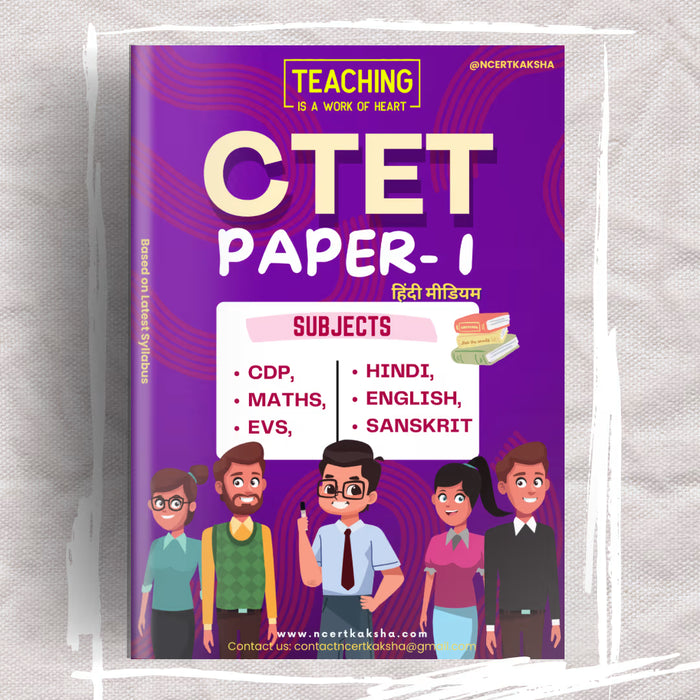
CTET Paper 1 rewards the candidate who has both the pedagogy theory and the primary-level subject content organised in one place. The syllabus looks large — five sections, each with its own pedagogy — but almost every section is dominated by Child Development & Pedagogy thinking, and the subject content is at primary (Class 1-5) level. Concise, colour-coded notes that pair each subject with its teaching pedagogy are what let you revise the whole paper quickly and remember the high-yield MCQ points.
This guide maps the essentials of the whole CTET Paper 1 syllabus — the same map inside the NCERT Kaksha CTET Paper 1 Notes.
📌 What's in this guide
CTET Paper 1 Exam Pattern & Marks
CTET Paper 1 is a 150-question, 150-mark paper to be completed in 2.5 hours, with no negative marking. The five sections each carry 30 marks: Child Development & Pedagogy, Language I, Language II, Mathematics, and Environmental Studies. You need 60% to qualify (90/150), with the usual relaxation for reserved categories. Because every section carries equal marks and pedagogy runs through all of them, no section can be safely skipped.
What's Inside the NCERT Kaksha CTET Paper 1 Notes
- ✅ Complete CTET Paper 1 syllabus — all 5 sections for teaching Class 1-5
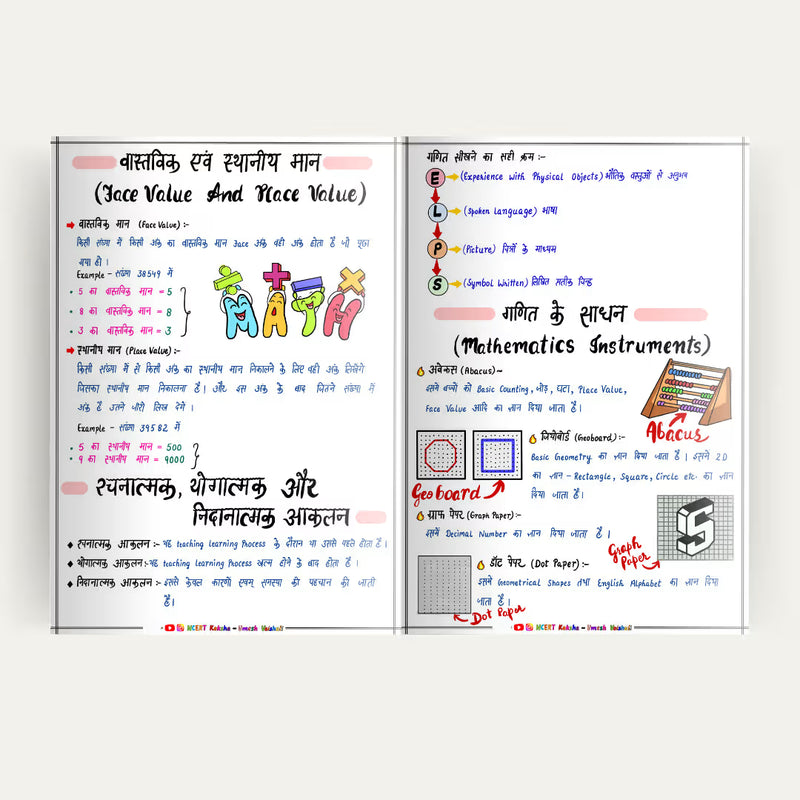
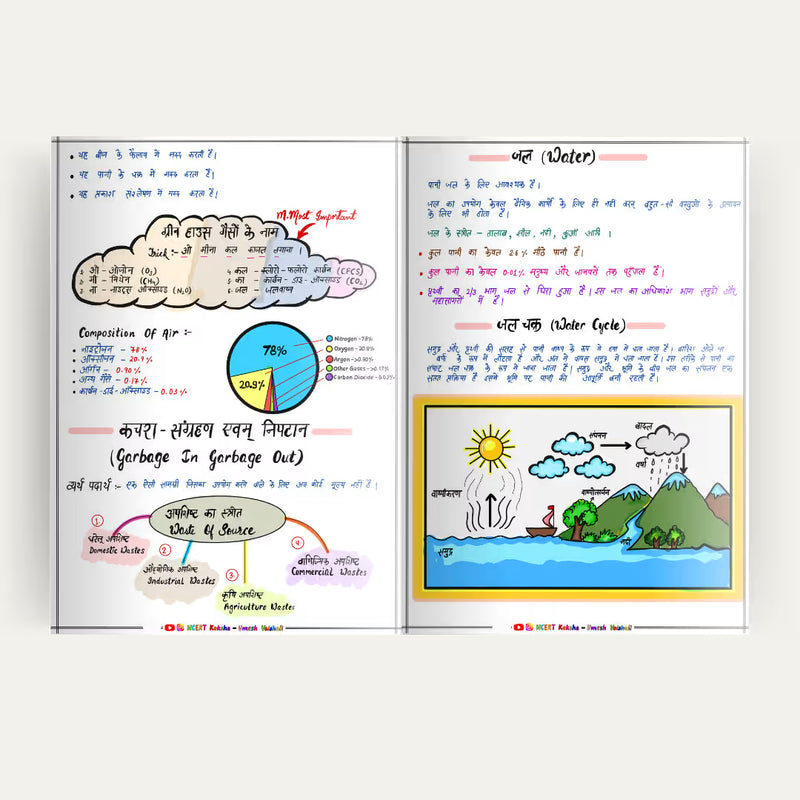
- ✅ Colour-coded, handwritten short notes — quick revision
- ✅ Pedagogy + subject content together in one place
- ✅ Important MCQs & high-yield points highlighted
- ✅ Latest 2026-27 CTET pattern, exam-ready
- ✅ Made by qualified teachers & toppers
- ✅ Choose Printed or instant PDF · also available as P1+P2 combo
See How Colourful & Organized the Notes Actually Are
Full Syllabus — Section by Section You Cannot Skip
1Child Development & Pedagogy (30 marks)
Focus on: child development principles, learning theories (Piaget, Vygotsky, Kohlberg), inclusive education, concept of learning, motivation, and assessment — the highest-weight, most repeated section.
2Language I (30 marks)
Focus on: reading comprehension, plus language pedagogy — principles of language teaching, learning & acquisition, and remedial teaching.
3Language II (30 marks)
Focus on: comprehension in your second language, grammar, and language-development pedagogy (the same teaching principles applied to Language II).
4Mathematics (30 marks)
Focus on: primary-level number system, geometry, measurement & data handling, plus Maths pedagogy — the nature of maths, evaluation, and remedial teaching.
5Environmental Studies / EVS (30 marks)
Focus on: family & friends, food, shelter, water, travel, things we make & do, plus EVS pedagogy — concept, significance, and activity-based teaching.
How to Use the Notes the Right Way
Sirf notes khareedne se selection nahi hota. This is how our top CTET candidates use them:
1. Master pedagogy first
CDP and the pedagogy embedded in every section is the biggest, most repeated scorer. Lock the learning theories and teaching principles before the subject content.
2. Solve previous-year MCQs section by section
CTET repeats question patterns heavily. For each section, work through past-year MCQs with the notes open.
3. Revise all five sections in rotation
Because every section is 30 marks, give them equal attention. Rotate through them so none goes stale.
4. Two cold passes before the exam
One full pass a week out, one quick pass on exam morning focusing on pedagogy and MCQ points.
Keep an "Error List" — the habit that saves marks
Note the pedagogy terms and theorists you keep confusing. In the final days, read only this list.
Coaching Books vs. Short-Notes Revision
| Approach | Thick Coaching Books | NK Short Notes |
|---|---|---|
| Time to revise full paper | Many hours | Fast, focused passes |
| Pedagogy + subjects together | Separate books | One place |
| Important MCQs | Scattered | Highlighted |
| Portability | Stack of books | Compact notes |
| Cost | Thousands | ₹449 (PDF) one-time |
Why 2,390+ CTET Toppers Choose These Notes
CTET Paper 1 Handwritten Notes 2026-27 (Class 1-5)
- ✅ Made by qualified teachers & toppers — real exam insight
- ✅ Pedagogy + all 5 subjects in one place
- ✅ Colour-coded & concise — perfect for last-minute revision
- ✅ Trusted by 2,390+ CTET toppers (first-attempt success)
Frequently Asked Questions
Who should take CTET Paper 1?
CTET Paper 1 is for those who want to teach at the primary level, Class 1 to 5. If you want to teach Class 6 to 8, you need Paper 2 instead.
What is the CTET Paper 1 exam pattern?
150 MCQs / 150 marks in 2.5 hours, no negative marking, across five 30-mark sections: Child Development & Pedagogy, Language I, Language II, Mathematics and EVS.
Which subjects do the notes cover?
All five Paper 1 sections — Child Development & Pedagogy, Language I, Language II, Mathematics and Environmental Studies (EVS) — with pedagogy and important MCQs.
Which section is most important in CTET Paper 1?
Child Development & Pedagogy, plus the pedagogy embedded in Maths and EVS, carries the most weight and repeats across sections, so prioritise it.
Are the notes based on the latest CTET pattern?
Yes — they follow the latest 2026-27 CTET syllabus and pattern and are fully exam-ready.
Is it available as PDF or printed?
Both. Choose instant PDF (delivered to your email after payment) or a printed book. A Paper 1 + Paper 2 combo is also available.
What are the CTET qualifying marks?
You need 60% (90 out of 150) to qualify, with the usual relaxation for reserved categories as per CBSE norms.
Is there a discount?
Yes — use code TOPPER at checkout for 5% off. The P1+P2 combo saves more.
Ready to Clear CTET Paper 1 in One Attempt?
Join 2,390+ CTET toppers who revise smarter with NCERT Kaksha.
₹699₹449Use code TOPPER for 5% off · COD Available
📗 Order CTET Paper 1 Notes NowTeaching Class 6-8? Get CTET Paper 2 Notes · or the P1+P2 combo