
NEET Chemistry Formula Sheet & Short Notes 2026-27 — Every Chapter in One Revision Map
The complete chapter-wise NEET Chemistry guide 25,327+ aspirants trust — Physical, Inorganic & Organic, every formula, reaction & named reaction in one place. Revise in 25–55 minutes.
📗 Get the Short Notes — ₹199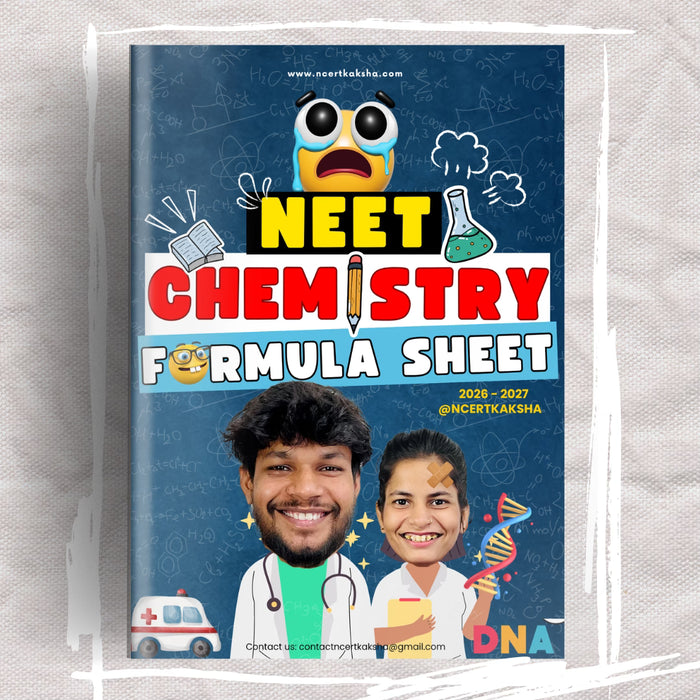
Chemistry is where NEET aspirants can bank marks — but only if the recall is instant. Physical Chemistry rewards clean formula application, Inorganic is pure memory of trends and reactions, and Organic is all about named reactions and reagents. Miss one reagent or trend and an easy mark is gone. Concise chapter-wise notes that separate the three branches make revision far faster.
This guide maps the essentials of the whole NEET Chemistry syllabus — the same map inside the NCERT Kaksha NEET Chemistry Short Notes.
📌 What's in this guide
Why NEET Chemistry Is Your Scoring Section
Of NEET's three sciences, Chemistry is the most "bankable" — a large chunk of questions are direct if your formulas, trends and named reactions are locked. Physical Chemistry (mole concept, thermodynamics, equilibrium, kinetics) is formula-driven; Inorganic (periodicity, bonding, coordination) is trend-and-fact based; Organic (GOC, functional groups, biomolecules) is reaction-based. Each needs a slightly different revision style — a good sheet separates them cleanly.
What's Inside the NCERT Kaksha NEET Chemistry Short Notes
- ✅ Complete NEET Chemistry syllabus — Physical, Inorganic & Organic, Class 11 & 12
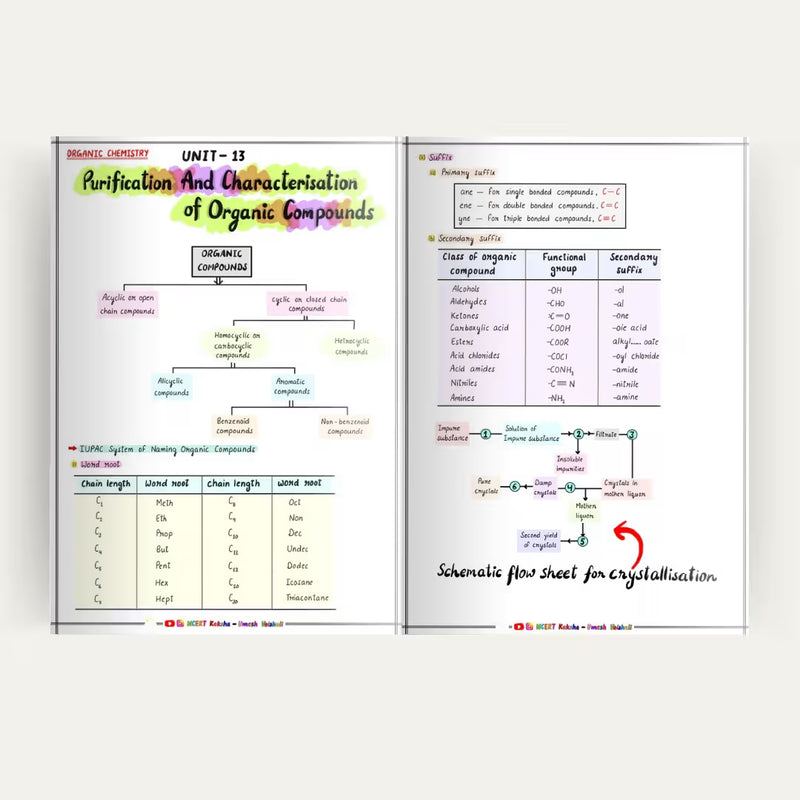
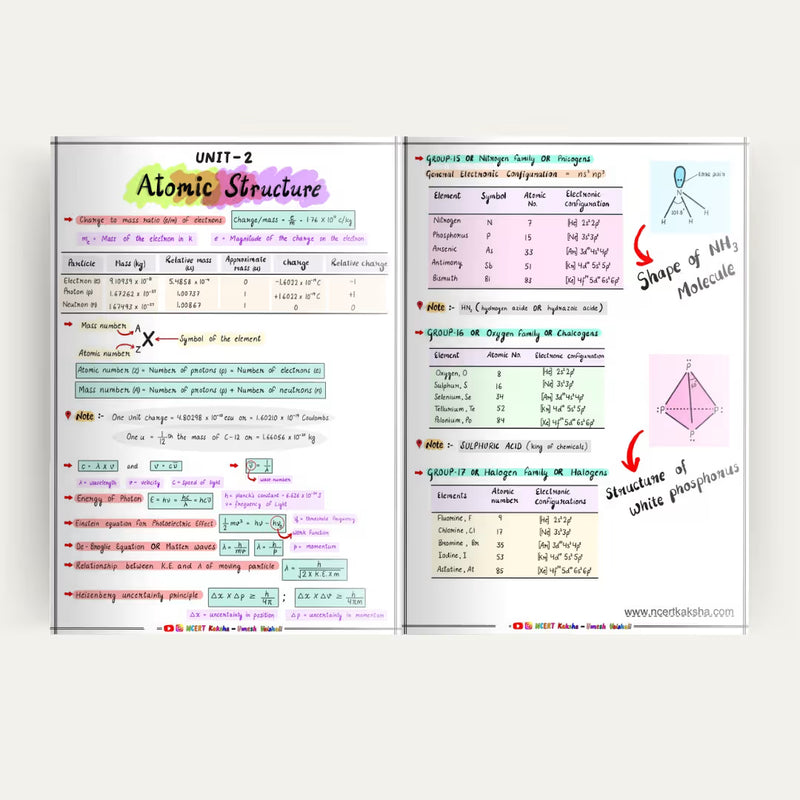
- ✅ 65 pages of colour-coded, handwritten notes
- ✅ Every formula, reaction & named reaction in one place
- ✅ Reagents, conditions & periodic trends highlighted
- ✅ A5 pocket size (21.2 × 14.8 cm)
- ✅ Made by District Toppers, NITians & IITians
- ✅ Choose Printed or instant PDF · Combos: Chem, Phy+Chem, PCB
See How Colourful & Organized the Notes Actually Are
Full Syllabus — Key Formulas & Reactions You Cannot Skip
Physical Chemistry
1Mole Concept & Stoichiometry
2Thermodynamics & Equilibrium
3Electrochemistry & Kinetics
Inorganic Chemistry
4Periodicity & Chemical Bonding
Focus on: periodic trends, VSEPR, hybridisation & molecular orbital theory.
5Coordination Compounds & p/d-block
Focus on: Werner's theory, nomenclature, isomerism, and key p- and d-block trends.
Organic Chemistry
6General Organic Chemistry (GOC)
Focus on: inductive, resonance & hyperconjugation effects, and reaction intermediates.
7Hydrocarbons & Functional Groups
Focus on: named reactions — Aldol, Cannizzaro, Markovnikov — reagents and mechanisms.
8Biomolecules & Everyday Chemistry
Focus on: carbohydrates, proteins, nucleic acids, and chemistry in everyday life — high-scoring, mostly conceptual.
How to Use the Short Notes the Right Way
Sirf notes khareedne se marks nahi milte. This is how our top NEET aspirants use them:
1. Split Physical, Inorganic & Organic
Revise the three branches in separate sittings so trends, formulas and reactions don't blur.
2. Drill named reactions daily
Aldol, Cannizzaro and the rest are near-guaranteed NEET marks. A daily 10-minute recall locks them in.
3. Solve PYQ numericals with the sheet open
Work through Equilibrium, Thermo and Electrochem NEET numericals until the formulas are automatic.
4. Two cold passes before the exam
One full pass a month out, one 30-minute pass on exam morning.
Keep an "Error List" — the habit that saves marks
Note the reagents, trends and formulas you keep slipping on. In the final week, read only this list.
Traditional Revision vs. Short-Notes Revision
| Approach | NCERT + Coaching Modules | NK Short Notes |
|---|---|---|
| Time to revise full Chemistry | 12–18 hours | 25–55 minutes |
| Formulas & reactions in one place | Scattered | Single section |
| Named reactions | Across modules | Colour-coded, ready |
| Portability | Stack of modules | A5 pocket size |
| Cost | Thousands | ₹199 (PDF) one-time |
Why 25,327+ NEET Aspirants Choose These Notes
- ✅ Made by District Toppers, NITians & IITians — real exam insight
- ✅ All named reactions, trends & formulas in one place
- ✅ Colour-coded & compact — revise the whole subject in under an hour
- ✅ Trusted by 25,327+ NEET aspirants
Frequently Asked Questions
How many questions is Chemistry in NEET?
NEET Chemistry has 45 questions worth 180 marks, split across Physical, Inorganic and Organic Chemistry from the full Class 11 and 12 syllabus.
Which is the best short notes for NEET Chemistry?
The NCERT Kaksha NEET Chemistry Short Notes — 65 pages covering the full syllabus with every formula, reaction and named reaction, handwritten by IITians and NEET toppers. Instant PDF ₹199.
How many pages is the NEET Chemistry notes book?
65 pages of handwritten, chapter-wise notes covering the complete NEET Chemistry syllabus.
Which topics are most important in NEET Chemistry?
Organic Chemistry (GOC + functional groups), Chemical Bonding and Physical Chemistry numericals (Equilibrium, Thermodynamics, Electrochemistry) are the highest-return topics, so prioritise them.
Do the notes cover named reactions and mechanisms?
Yes — every important named reaction (Aldol, Cannizzaro, Markovnikov and more), reagent and mechanism is laid out clearly in the organic section.
Is it available as PDF or printed?
Both. Choose Printed (A5, dispatched within 24 hours) or PDF (instant email delivery after payment).
How long does full Chemistry revision take with the notes?
Designed for fast revision — most aspirants finish a full pass in about 25–55 minutes, and an exam-day pass in under 30.
Is there a discount?
Yes — use code TOPPER at checkout for 5% off. PCB combos save more.
Ready to Bank Every NEET Chemistry Mark?
Join 25,327+ NEET aspirants who revise smarter with NCERT Kaksha.
₹199Use code TOPPER for 5% off · COD Available
📗 Order Chemistry Short Notes NowAlso in combos: Phy+Chem · PCB